Pixel Lineage Beginner Guide: Your First Normal Run
Start Pixel Lineage with a useful hero, prepare in the Castle, learn Normal combat and plan the next run without wasting spins or copying unverified builds.
Create a hero, read the class and race panels, equip a usable loadout in the Castle and choose a manageable Normal run. Practise attack and defence prompts before spending rerolls or increasing difficulty.
View reference image
On this page
Begin with one playable hero
Start Pixel Lineage from the official Roblox page, make a hero, choose a base class, and learn one Normal adventure before chasing rare rolls or higher difficulties. The developer calls this a fast turn-based roguelike RPG and warns that the early release can contain serious bugs. That makes a repeatable opening route more useful than a supposedly perfect build copied from an old tier list.
Your first target is modest: leave the Castle with a loadout you understand, complete ordinary encounters, and return knowing which decision caused trouble. A rare race cannot teach the timing prompts for you. Equally, a failed first run does not establish that your class is unusable. Work through setup, combat and equipment in that order so each attempt answers a practical question.
This is an independent, source-led route reviewed on October 15, 2026. It combines the official listing, the six-class promotional panel and dated player references. It is not a claim that our editors personally cleared the current build. Where menu details change, the live help and confirmation text take precedence.
Check the experience before using a guide
Open the place with ID 126256942507957, published by the Pixel Lineage community. The universe ID 10767928510 identifies the same experience in the public Roblox API. Those two numbers serve different platform purposes; neither is a redemption code.
The official listing says that basic controls and information are available in-game. Open those instructions before your first fight, particularly on a phone or controller. Keyboard instructions from a video may not match your device. If you cannot see the same action buttons, resolve that difference before selecting a harder encounter.
The listing also asks players to Like, Favorite and join the group for code redemption. It advertises OCTOBER on the review date. This establishes a developer-listed string, rather than a promise of a particular reward or a successful redemption on your account. Use the in-game redemption area and read its response; Roblox gift-card redemption is a different system.
Make the three opening choices deliberately
Race, talent and class describe different parts of a hero. A race supplies its own passive identity, a talent supplies another modifier, and a base class supplies the combat kit. Do not treat a Race Spin as a class change or assume a talent reroll also changes race.
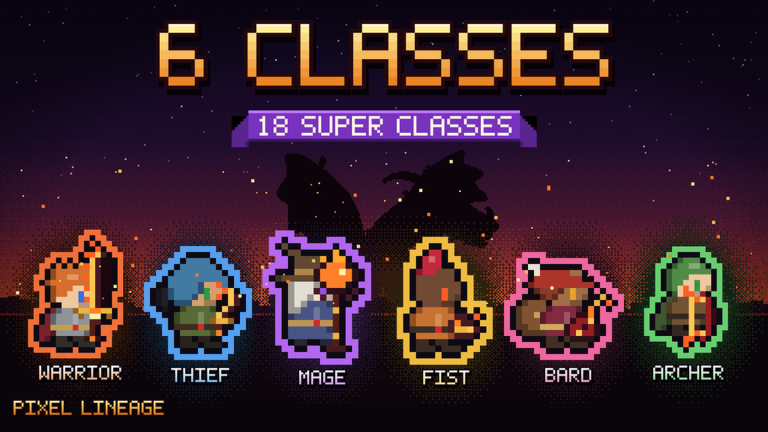
The official promotional class image names Warrior, Thief, Mage, Fist, Bard and Archer. Choose the kit whose displayed actions you understand. For a first character, simplicity is a useful selection criterion: can you explain what your basic attack does, what your defensive response is, and when a skill can be used? Answer those questions before comparing late-game branches.
| Opening decision | Read before confirming | Useful first-session result |
|---|---|---|
| Race | Current passive and any evolution preview | A bonus you can recognise during play |
| Talent | The exact effect and trigger condition | A modifier that fits actions you actually use |
| Class | Starting skills and any reset warning | A kit you can practise without guessing |
| Difficulty | Encounter and reward description | A manageable place to learn the interface |
Save optional rerolls until you can name the limitation they would address. If you are missing attack or defence prompts, changing race is unlikely to solve the immediate problem. If your class uses magic while your desired bonus only affects attacks, then race fit becomes a more useful question. The race evolution guide explains how to compare the two layers without spending materials prematurely.
Prepare in the Castle before selecting Set Out
Player walkthroughs identify the Castle as the hub for departure and equipment preparation. Locate the gear inventory, the visible recovery or supply options, and the Set Out control. Read the next screen before accepting it; a visible button is not proof that the selected hero is prepared for every available difficulty.
Check that the intended weapon and other usable items are equipped. An item in inventory is not necessarily active. Read its slot and restrictions, then confirm that the equipped marker or character panel changes. This simple check avoids testing a build that still has an old item selected.
If a town service asks for Gold, inspect the service it unlocks before spending. Buy the improvement that addresses your current problem rather than repairing every building immediately. A player who cannot survive basic encounters has a different priority from one who survives but cannot manage stored loot. This is a planning recommendation, not a fixed repair order or an undocumented price list.
Learn on Normal and watch each prompt
The linked beginner references recommend Normal for initial learning. Treat that as the editorial default for an unfamiliar hero. Hard, Nightmare and Torment appear in current player discussion, but a higher label does not guarantee a better result once failed attempts and preparation time are included.
Turn-based combat still asks for attention. The player references describe timed attacks and defensive responses, so watch the prompt instead of repeatedly pressing a remembered key. Use early encounters to learn where feedback appears: successful input, damage taken, remaining health and the resource needed by your next skill.
When a skill is unavailable, inspect its explanation. A resource shortage, cooldown or other condition requires a different response from an input mistake. Do not spend the next turn repeating an unavailable action. Pick a legal action, preserve enough room for the next decision, and examine the resource panel after the encounter.
A useful practice sequence is to repeat one basic attack until its feedback is recognisable, then concentrate on defence, then add a skill. Changing all three at once makes it difficult to tell why a fight improved. This sequence is our learning method; it is not a hidden damage bonus.
Read route choices as costs and outcomes
Between encounters, compare the available route or event choices before selecting one. Read any stated cost, possible reward and risk indicator together. A reward icon alone does not tell you whether the event consumes health, currency or another resource you need later.
Do not copy an advanced farming route merely because the creator moves through it quickly. Their established gear, evolved race or familiarity with enemies may supply the safety margin your hero lacks. For a first run, favour understandable encounters and preserve useful supplies for a fight you have not seen.
If an event result surprises you, note the option you selected and the visible consequence. On the next attempt change that decision instead of rerolling the entire hero. The dungeon preparation guide provides a checklist for separating entry requirements, current equipment and encounter readiness.
Turn the first run into a clearer second run
After the run, inspect new equipment before selling, consuming or replacing it. Compare the actual displayed effects with your existing piece. A higher-looking rarity does not automatically resolve an incompatible slot or a bonus aimed at the wrong action type.
Choose one adjustment for the next attempt. If normal attacks felt manageable but defence failed, practise the defensive prompt. If the hero ran out of a resource, review skill timing. If damage was acceptable but the next difficulty overwhelmed you, repeat the current setting while improving gear instead of pushing immediately.
Keep a short record: class, difficulty, the encounter that stopped you, and one intended change. There is no need to record every animation. A useful record turns an unclear build complaint into a specific missed prompt or unequipped item, which gives you a concrete recovery route.
Before the next Set Out
Confirm the correct experience, the intended class, equipped gear, current supplies and selected difficulty. Read any warning concerning hero resets or lost progress before accepting it. This guide does not establish a universal recovery rule for every item, so do not rely on an old video when a current confirmation screen says otherwise.
Return to the Pixel Lineage hub when you want the source links or the full reading order. Continue with dungeons for an entry checklist, and race evolution once you can already complete a reliable farming route. A repeatable run gives every later upgrade a better test.
Step-by-step guide
- Prepare one understandable hero
Choose one of the six displayed base classes, read its actions and inspect race and talent effects before spending additional spins.
- Check the Castle loadout
Confirm equipped items, supplies and the exact Set Out selection; read costs and reset warnings before accepting them.
- Use Normal as a learning baseline
Practise attack and defence feedback, inspect new gear after the run and change one cause of failure for the next attempt.
Quick reference
First-session route
| Stage | Action | Checkpoint |
|---|---|---|
| Identity | Open place 126256942507957 | Pixel Lineage community is the creator |
| Hero | Read class, race and talent | You can explain the starting kit |
| Run | Select a manageable Normal route | Recognise timing and resource feedback |
| Return | Inspect equipment and one failure cause | One clear improvement for next run |
Video evidence
Watch creator walkthroughs alongside this guide. Check the recording date before following requirements that may have changed.
Pixel Lineage Beginner Guide - The BEST Start for New Players!
Compare the castle, run setup and update interface with your own game; creator advice is separate from developer rules.
FAQ
Is this an official developer guide?
No. This is independent fan guidance. Developer descriptions, dated player reports and original planning recommendations are identified separately.
What if the game shows a different requirement?
Follow the current item tooltip, help panel and confirmation message. Send the exact mismatch and date through Contact so the affected claim can be reviewed.
Sources
Recheck these links whenever the game version, release status, or strategy changes.
- Official Pixel Lineage experience Developer identity, genre, early-release warning and in-game controls; reviewed 2026-10-15.
- Official Roblox game API Universe 10767928510, root place 126256942507957 and creator community 362755399.
- Gamezebo race guide, October 13 Attributed report of race passives and matching Heirloom / Heart Blood; conflicting numbers omitted.
- Destructoid Race EVO discussion, October 13 Independent build comparisons and base-versus-evolved distinction.
- Dated first-run player reference Castle, Set Out and Normal learning route; player advice, not official requirements.
- Pixel Lineage Beginner Guide - The BEST Start for New Players! Metadata and public embed availability verified; caption requests returned HTTP 429.
- Pixel Lineages NEW UPDATE! Everything You NEED to Know + FAST Gold Farming! Metadata and public embed availability verified; caption requests returned HTTP 429.